Case Studies

Real outcomes from commercial and operational initiatives

Summaries drawn from direct experience leading commercial transformations across industries, demonstrating what becomes possible when incentives, accountability, and execution are properly aligned.

Alex Naumov
Alex Naumov
Managing Director, Rospex Holdings
3 case studies  ·  April 2026
Small restaurant chain
Case study summary
01
Fast-casual restaurants · Multi-location chain
Incentives drive immediate behavior change: small restaurant chain

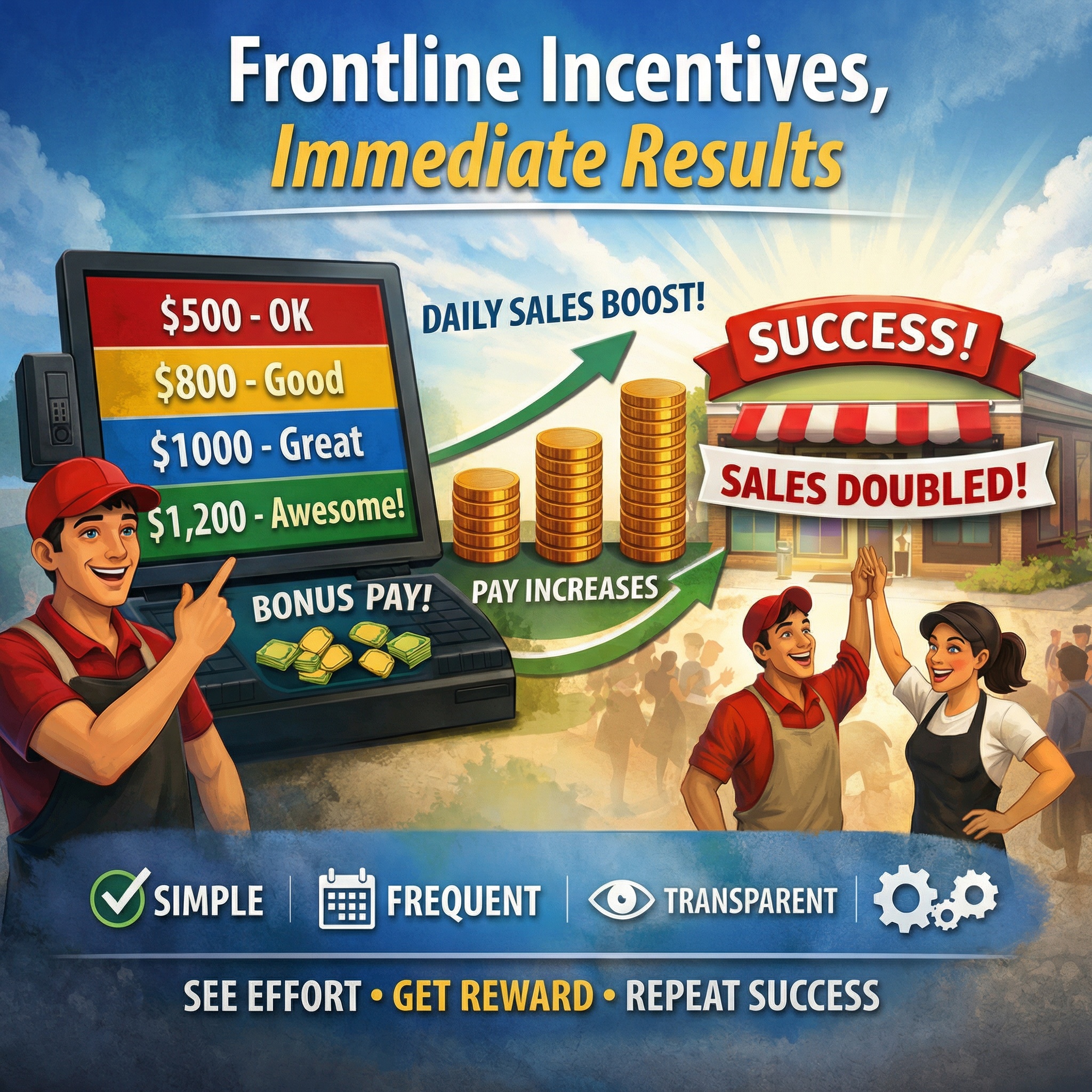
In one of my early ventures, I ran a small regional chain of fast-casual restaurants. Sales were flat, and motivation varied by location. The business had good product and reasonable foot traffic, but the compensation structure gave frontline staff no reason to perform beyond the minimum.

We redesigned compensation around daily revenue buckets. As staff moved to a higher daily revenue level, their hourly pay increased. The connection between effort and earnings became visible every single day at POS close. No complex formulas. No quarterly reviews. A number on a screen at the end of every shift.

Within two months, all seven locations grew. One doubled sales. Others grew 45-60%.

Sales at the best location
45-60%
Growth at other locations
2 months
Time to results
The lesson

When compensation is simple, transparent, immediate, and controllable at the frontline level - behavior changes fast. People can see what to do tomorrow to earn more. That visibility is more powerful than any management initiative.

Interested in applying this to your business?
Reach out to discuss how a redesigned incentive structure could work in your specific situation, or to learn more about the full case study.
Start a conversation →
Management services company
Case study summary
02
Management services · $600M revenue company
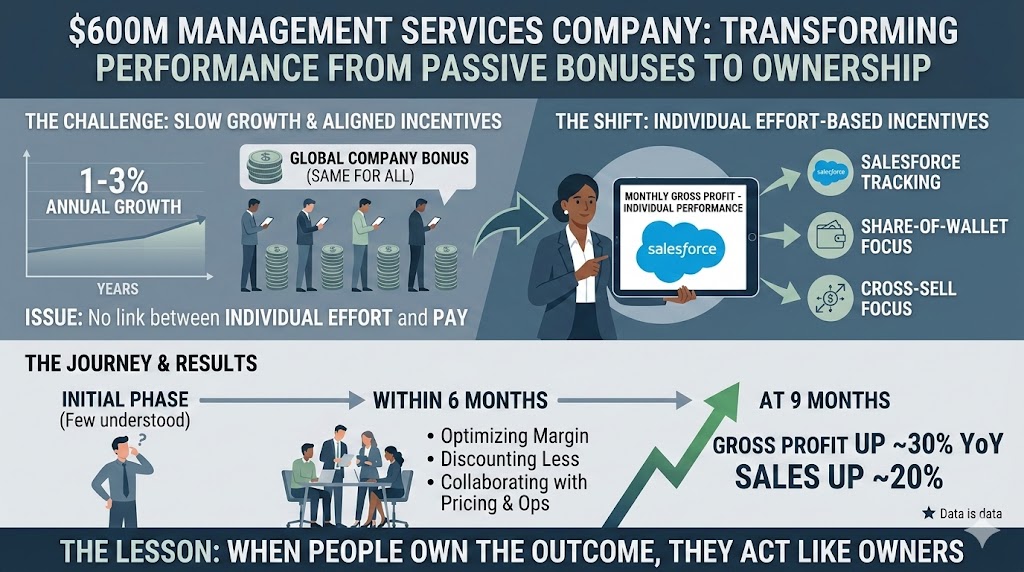
From passive bonuses to ownership: when people own the outcome, they act like owners

This service company had grown only 1–3% annually for years. The issue wasn't talent: it was incentives. Everyone received the same bonus based on overall company results. Individual effort had no visible link to pay. Good performers and average performers were rewarded identically.

We shifted to a monthly gross profit–based plan tied to individual performance, supported by Salesforce tracking and validation. We also introduced share-of-wallet and cross-sell focus, giving each person a clear picture of their own commercial opportunity.

At first, few understood it. Change was uncomfortable. Within six months, most were actively optimizing margin, discounting less, and collaborating more with pricing and operations. The metrics weren't just being tracked — they were being owned.

+30%
Gross profit YoY
+20%
Sales growth
9 months
Time to results
The lesson

When people own the outcome, they act like owners. Collective bonuses create collective mediocrity. Individual accountability, properly designed and clearly communicated, creates energy that no management directive can replicate.

Want to implement something similar?
Alex is glad to discuss how this type of commercial redesign could apply to your business, with no obligation and in complete confidence.
Start a conversation →
Global manufacturer
Case study summary
03
Manufacturing · Global multi-region organization
Individual accountability changes culture: global manufacturer exceeds historic peak

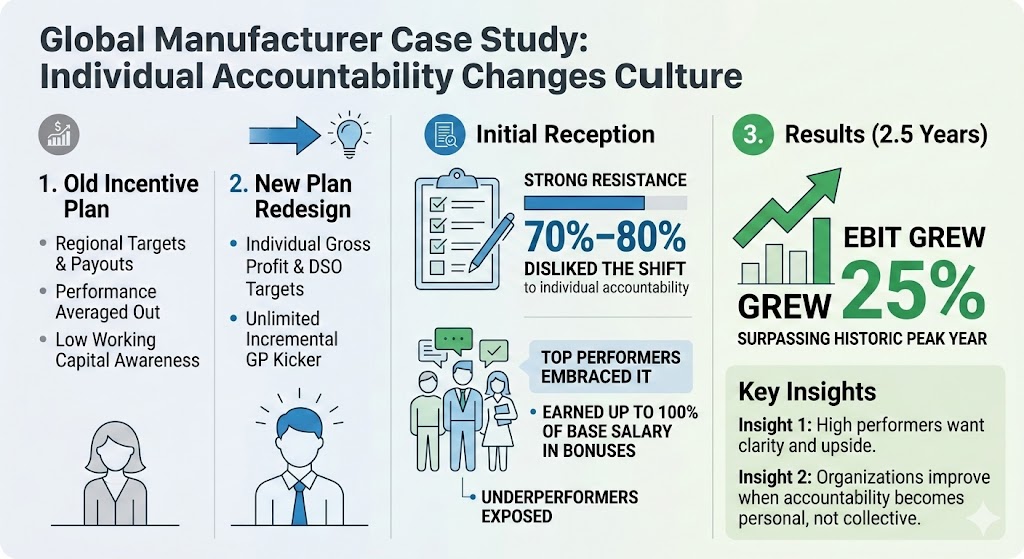
Across four regions, sales incentives were based on regional targets. Payouts were semiannual. Few people understood working capital metrics. Strong individual performance was averaged out by weaker regional results, and the best performers had no visibility into how their work translated to personal reward.

We redesigned the plan around individual gross profit and DSO targets, plus an unlimited incremental gross profit kicker. No ceiling on upside for high performers. Clear personal accountability for working capital discipline.

Initial resistance was significant: 70–80% of the organization disliked the shift to personal accountability. But top performers embraced it immediately, earning up to 100% of base salary in bonuses. Over time, more followed. Underperformers were exposed by the transparency of the new structure rather than by management intervention.

+25%
EBIT growth
100%
Max bonus: top performers
In 2.5 years
Highest EBIT Historically
The insight

High performers want clarity and upside. Organizations improve when accountability becomes personal, not collective. The discomfort of the transition is temporary. Once embedded, the cultural shift is durable and compounds over time.

Thinking about a similar transformation?
Whether you're considering selling and want to improve performance first, or simply want to discuss how these principles could apply - reach out directly for a confidential conversation.
Start a conversation →

Seen something that resonates?

Every business is different, but the principles behind these results are transferable. If you'd like to talk through how they might apply to your situation, Alex is glad to have a candid, no-obligation conversation.

Start the conversation →
Back to resource library